
Warehouse Compliance
HAZMAT & COMAH storage,continuously audited.
WareBee audits your warehouse against the rules it has to follow — dangerous goods, storage policies, racking weight, fire safety — continuously, and alerts you the moment reality drifts from the plan. No spreadsheets, no waiting for the next inspection.
Audit your warehouse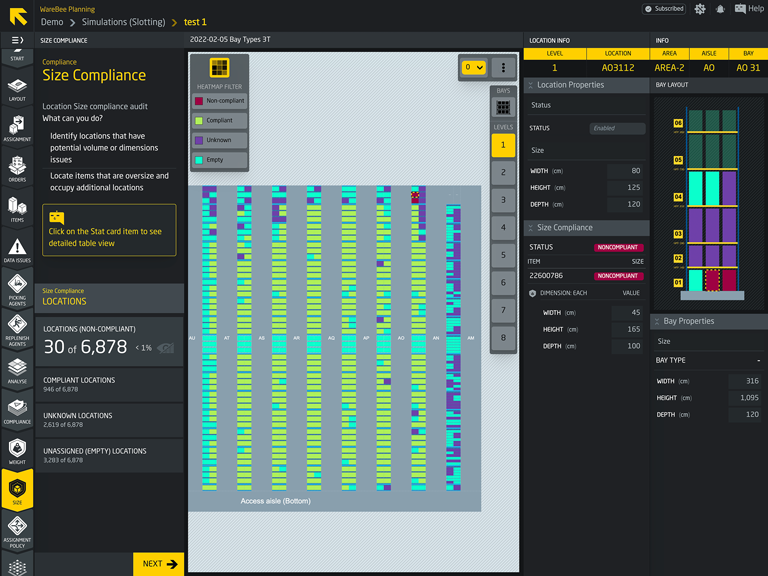
Store dangerous goods by the book
HAZMAT compliance is a maze of overlapping regimes — COMAH (UK), Seveso (EU), RMP (US) — and getting segregation wrong puts people, stock and the building at risk. WareBee enforces your dangerous-goods rules on the actual layout, flagging incompatible stock, missing separation and locations that break policy.
The same engine handles allergen separation and any custom storage policy you configure — so 'compliant' stops being a quarterly panic and becomes a state you can prove any day of the week.
- HAZMAT / COMAH / Seveso / RMP segregation enforced on the layout
- Allergen separation and custom storage policies
- Non-compliant locations identified automatically
What WareBee checks
Six ways your warehouse can drift out of compliance. All watched.
Every check runs continuously against your digital twin — on your real stock, your real layout, your own policies.
HAZMAT & COMAH segregation
Dangerous goods stored and separated per COMAH, Seveso and RMP — incompatibilities flagged before they co-locate.
Every substance pair with a known incompatibility is mapped once and cross-checked against every putaway decision as it's made, not reconstructed after an inspector asks for the paper trail. Each check leaves a timestamped record, so the evidence an audit wants already exists before the visit is booked.
Dangerous-goods zones
Validate that hazardous stock sits only in the zones rated for it, and nothing has crept in that shouldn't.
Zone ratings are compared against the hazard class of whatever's actually stored there on every location change, not just at the original licensing survey. The item that was moved in as a one-off exception and never moved back out is exactly the drift this check is built to surface.
Allergen separation
Keep allergen-bearing stock apart from what it can contaminate — audited, not assumed.
Contamination-risk pairs are defined once and checked at every movement — putaway, replenishment, pick — not only when the slotting plan was first drawn up. A new SKU arriving near an allergen it can't safely sit beside gets caught before the pallet is set down, not after a customer complaint traces it back.
Racking weight limits
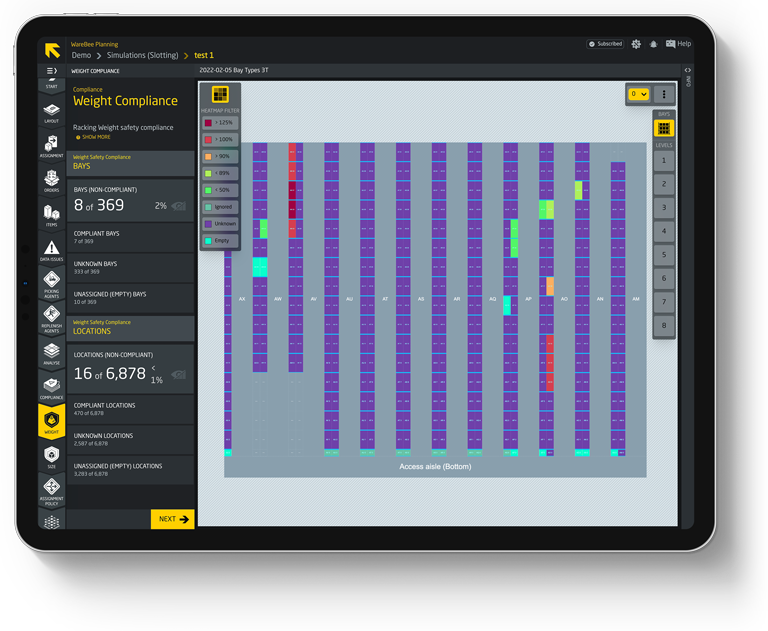
Spot overloaded bays before a rack collapses — weight policy enforced across every location.
Bay-level weight is tallied continuously against the rated load for that beam, aisle by aisle, rather than checked at the last stocktake. A bay trending toward its limit gets flagged while there's still time to redistribute the load — the difference between a maintenance ticket and an incident report.
Oversized locations
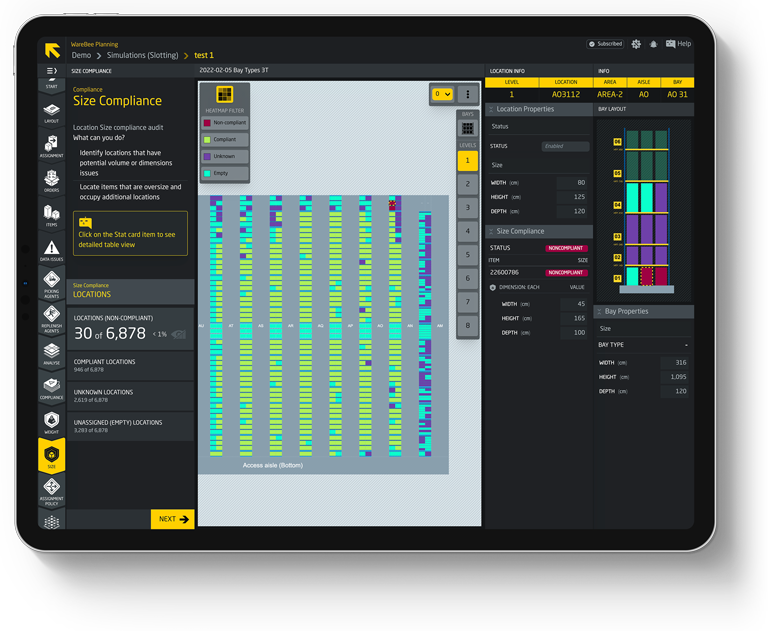
Find pallets blocking locations they overhang, eating capacity and creating access hazards.
Pallet footprint is checked against the slot envelope at the moment of putaway, catching an overhang into the aisle or the next bay before it settles in as a standing obstruction. What would otherwise be discovered by a forklift operator working around it gets logged and corrected first.
Fire safety
Audit against NFPA (US), EFSN (EU) and BS EN 12845 (UK); optimise sprinkler coverage and reduce fire risk.
Sprinkler coverage is modelled against the actual stock height and commodity class in each aisle, not the coverage the building was designed for on day one. Where storage has crept taller or denser than the original rating assumed, the gap between design and reality is flagged before an inspector or an insurer finds it first.
Monitored continuously. Flagged in real time.
Compliance isn't a snapshot — it drifts the moment stock moves. WareBee monitors your operation continuously and raises an alert the instant reality diverges from policy: a HAZMAT item in the wrong bay, an overloaded rack, a process step skipped.
It watches the process too, not just the storage — checking that steps run in the correct sequence and flagging operational decisions that stray from plan. Problems get caught as they happen, not discovered at the next audit.
- Real-time alerts when reality drifts from the plan
- Process compliance — steps performed in the right order
- Plan monitoring flags decisions that stray from policy
Learn more
What is warehouse compliance software?
Warehouse compliance software checks that stock is stored and handled the way regulations and your own policies require — and keeps checking, so a warehouse that was compliant this morning doesn't quietly drift out of it by the afternoon. For facilities handling hazardous materials, that means HAZMAT regimes like COMAH, Seveso and RMP; for everyone, it means storage rules, racking weight, fire safety and process discipline.
WareBee runs compliance on your warehouse digital twin. Because the twin already models every location, item and movement, it can audit dangerous-goods segregation, allergen separation, weight limits, oversized locations and fire-safety standards against your real stock — continuously, and against your custom policies, not just a generic template.
The payoff is proof on demand and problems caught early: real-time alerts the moment reality diverges from plan, an audit trail for inspectors, and one less quarterly fire drill. Compliance becomes a state you can demonstrate any day, not a scramble before the next visit.
Frequently asked questions
How WareBee audits HAZMAT, storage and fire-safety compliance continuously on your digital twin.
What is warehouse compliance software?
It checks that stock is stored and handled the way regulations and your own policies require — and keeps checking, so a warehouse that's compliant this morning doesn't quietly drift out of it by the afternoon. WareBee runs those checks on your digital twin, against your real stock and layout.
Which dangerous-goods regimes does WareBee cover?
WareBee enforces HAZMAT segregation across COMAH (UK), Seveso (EU) and RMP (US), applying the rules on your actual layout and flagging incompatible stock, missing separation and locations that break policy. The same engine handles allergen separation and any custom storage policy you configure.
What does WareBee check besides HAZMAT segregation?
Six areas in all: HAZMAT and COMAH segregation, dangerous-goods zones, allergen separation, racking weight limits, oversized locations, and fire safety — audited against NFPA (US), EFSN (EU) and BS EN 12845 (UK). Each runs continuously against your digital twin.
How does continuous auditing differ from a periodic inspection?
Compliance drifts the moment stock moves, so WareBee monitors continuously and raises an alert the instant reality diverges from policy — a HAZMAT item in the wrong bay, an overloaded rack, a step skipped. Problems are caught as they happen, not discovered at the next audit.
Does WareBee check the process, not just where stock sits?
Yes. It watches the process too, checking that steps run in the correct sequence and flagging operational decisions that stray from plan. That's process compliance alongside storage compliance, both monitored in real time.
Can I prove compliance to an inspector on demand?
Yes. Because auditing is continuous, compliance becomes a state you can demonstrate any day rather than a scramble before the next visit — with real-time alerts when reality drifts and an audit trail for inspectors. No spreadsheets, no waiting for the next inspection.