
Warehouse AI Consultant
Your warehouse'salways-on AI consultant.
WareBee audits your operation on a digital twin built from your own data, benchmarks it against industry standards, and hands you a prioritised improvement roadmap — every recommendation simulated and quantified before you act.
Get your warehouse audit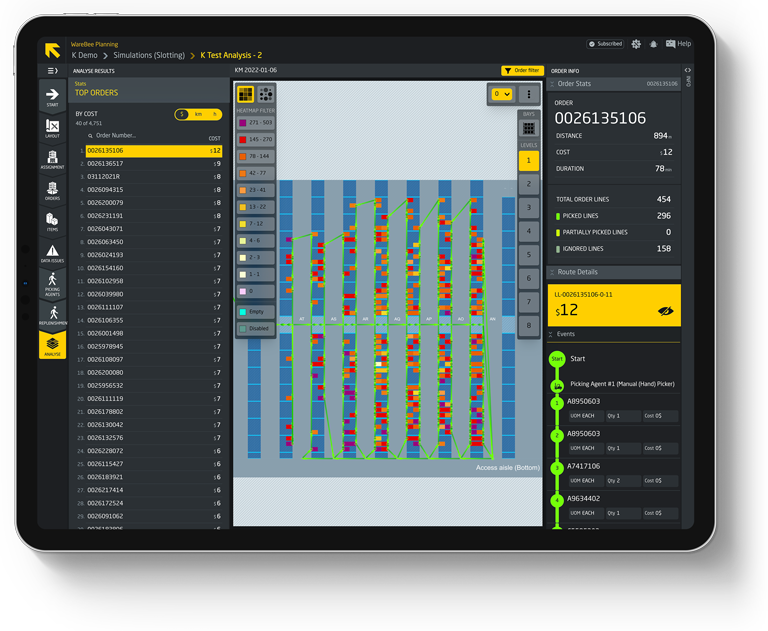
How it works
A consultant that never leaves the floor.
WareBee works the way a good consultant would — but continuously, on a live digital twin of your warehouse, and with the maths to back every recommendation.
Audit your operation
Layout, locations, stock and order history flow in through the Universal WMS API and become a digital twin — a simulation-ready copy of your warehouse the AI can inspect end to end.
No weeks-long site visit or shadowing shifts with a clipboard — the connection runs once, historical orders backfill the model, and the result is ready to interrogate within days. Everything a consultant would normally have to observe in person is already sitting in the data your systems produced anyway.
Benchmark vs industry
Cost to serve, space and resource utilisation, travel and CO₂ are measured against industry standards, so you see exactly where your warehouse leads and where it lags.
The comparison set is matched to your sector and operation size, not a single blended industry average that flatters some warehouses and unfairly damns others. Where you sit gets revisited as the standards themselves move, so the benchmark stays current rather than quoting a report from a few years back.
Find the cost drivers
Root-cause analysis drills into the productivity and cost drivers behind the numbers — dead stock, long travel, congestion, mis-slotted SKUs — and ranks them by impact.
Each driver traces back to a specific cause on the floor — the aisle where congestion actually forms, the SKU whose slot is wrong, the shift where travel time balloons — rather than stopping at a category label like “layout inefficiency” that nobody can act on directly.
Prioritised roadmap
You get a ranked improvement plan, not a data dump: the highest-return changes first, each with the effort, the affected zones and the expected result spelled out.
Sequencing accounts for what depends on what — a slotting change that has to land before an automation business case can be tested, for instance — not just a flat ranking by return. As each item ships, the plan re-sorts itself against what's left, instead of staying frozen as a document from the kickoff meeting.
Quantified ROI
Every recommendation carries a number — travel saved, throughput gained, cost avoided — grounded in your own orders, with a typical 10–15% operational-cost saving.
The figure attached at proposal doesn't stop being checked once a recommendation ships — actual results are tracked against what was promised, so the business case is validated against outcomes instead of resting on the modelling that produced it. A forecast that never gets revisited is just an estimate with confidence added.
Every recommendation simulated
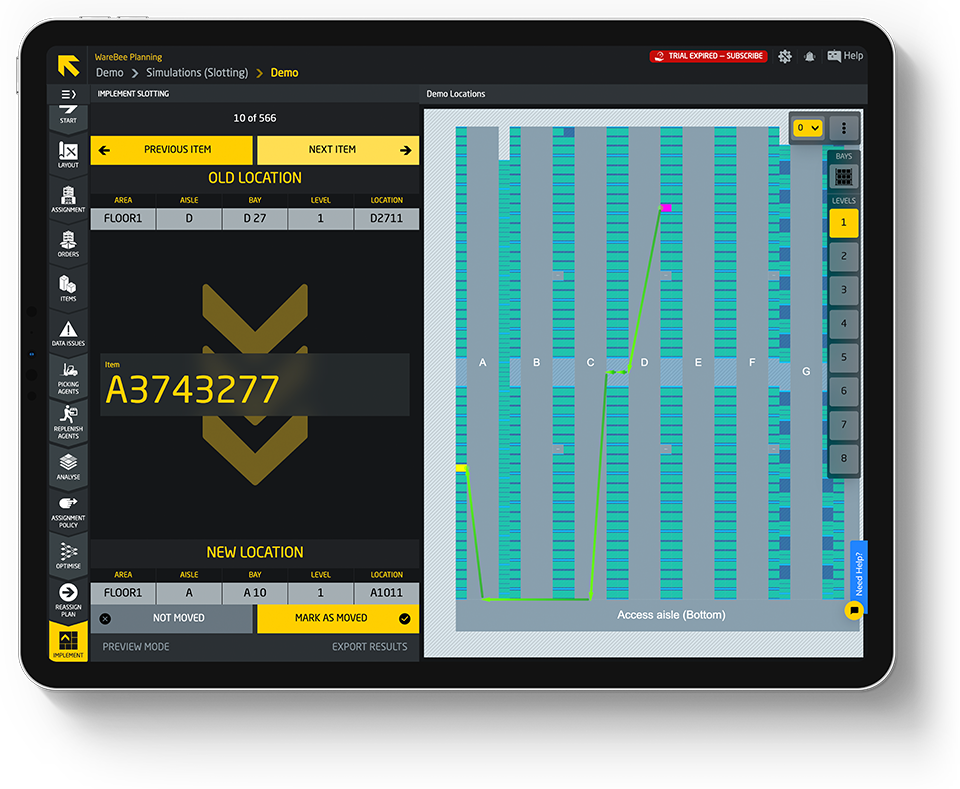
Before a change reaches your roadmap it is tested in the digital twin against your real orders, so the advice you act on has already been proven in a copy of your warehouse.
The replay uses your busiest weeks on record, not an average one, so a recommendation that only works when demand is calm never makes it onto the roadmap in the first place. What you see is the plan that survived the stress test — the ones that didn't hold up were quietly dropped before you ever saw them.
Advice with receipts
A consultant is only as good as the evidence behind the advice. Before WareBee recommends a move, it has already tested it: the change is simulated in your digital twin against your real orders, and the result — travel saved, throughput gained, cost avoided — comes attached.
Your team reviews the evidence, approves the change, and your WMS executes it. WareBee proposes, your people decide — nothing about how they work has to change.
- Every recommendation simulated before you see it
- Before-and-after numbers for every proposed change
- Your team approves, your WMS executes
From benchmark to a roadmap you can act on
The audit tells you where you stand against industry standards. The roadmap tells you what to do about it. WareBee turns the benchmark into a ranked plan — the highest-return changes first, each tied to the zones it touches and the result it should deliver.
It stays current because the twin does. As your orders, stock and layout change, the AI consultant re-runs the analysis, so the roadmap reflects the warehouse you are running today, not the one you modelled last quarter.
- Ranked by return, not by whoever shouted loudest
- Each step scoped to zones, effort and expected result
- Continuously refreshed as your operation changes
Learn more
How does a warehouse AI consultant work?
It starts with your data, not a generic template. Layout, locations, items, stock and order history flow in through the Universal WMS API — REST, scheduled exports or a simple CSV — and become a digital twin: a simulation-ready copy of your warehouse the AI can audit end to end.
From there it works like a consultant on a permanent engagement. It benchmarks your operation against industry standards, runs root-cause analysis on the cost and productivity drivers, and turns the findings into a prioritised roadmap — the highest-return changes first. Every recommendation is simulated in the twin against your real orders before it reaches you, so the advice arrives with the numbers behind it.
People stay in the loop by design: WareBee proposes, your team decides, and approved changes flow back to your WMS for execution — a typical saving of 10–15% of operational costs. Start with a paid pilot on your own data and judge the AI consultant by the only measure that matters: what it finds in your warehouse.
Frequently asked questions
What a warehouse AI consultant does, what it delivers, and how your team stays in control.
What is a warehouse AI consultant?
It is WareBee AI working like a consultant on a permanent engagement: it audits your warehouse on a digital twin built from your own data, benchmarks it against industry standards, finds the cost drivers, and hands you a prioritised improvement roadmap — every recommendation simulated and quantified before you act.
How is this different from WareBee's AI agents?
The AI agents — The Scout, The Analyst and The Coach — watch the floor and run the day to day. The AI consultant is the advisory layer over the same digital twin: it steps back, benchmarks the whole operation and produces the strategic roadmap, so the two work together rather than overlap.
What does the AI consultant actually deliver?
A ranked improvement plan, not a data dump. You get the highest-return changes first, each tied to the zones it affects, the effort involved and the expected result — travel saved, throughput gained or cost avoided — with the simulated numbers that back it up.
How does it benchmark my warehouse?
It measures cost to serve, space and resource utilisation, travel and CO₂ from your own data and compares them against industry standards. That shows where your warehouse already leads and where it lags, so the roadmap targets the gaps that cost you the most.
Will it make changes without my team approving?
No. People stay in the loop by design: WareBee proposes, your team decides, and only approved changes flow back to your WMS for execution. Nothing about how your people work has to change, and every recommendation arrives with the evidence for the team to review first.
How do I get started?
Start with a paid pilot on your own data. Layout, locations, items, stock and order history flow in through the Universal WMS API — REST, scheduled exports or a simple CSV — and become your digital twin, so you can judge the AI consultant by what it finds in your warehouse.