
Alert Engine
The warehouse tells youbefore it breaks.
WareBee's Alert Engine watches your operation continuously and notifies the right person the moment reality drifts from plan — a HAZMAT item in the wrong bay, a rack over weight, a pick rate sliding, a cost creeping. You set the thresholds; it does the watching.
Set up your alerts
Configure the thresholds that matter
Generic alerts get ignored. WareBee's Alert Engine lets you set bespoke rules on the metrics your operation actually cares about — a compliance breach, an overloaded bay, a pick rate below target, a cost-per-order creeping up — so every alert that fires is one worth acting on.
No code, no data team. Set the threshold on any KPI the twin already tracks, and WareBee watches it continuously.
- Bespoke rules on any KPI the twin tracks
- Compliance, productivity and cost — your thresholds
- No code, no report tickets
Always watching
What the Alert Engine watches for you.
The Scout monitors the feeds; the Alert Engine decides what's worth your attention — on your rules, in real time.
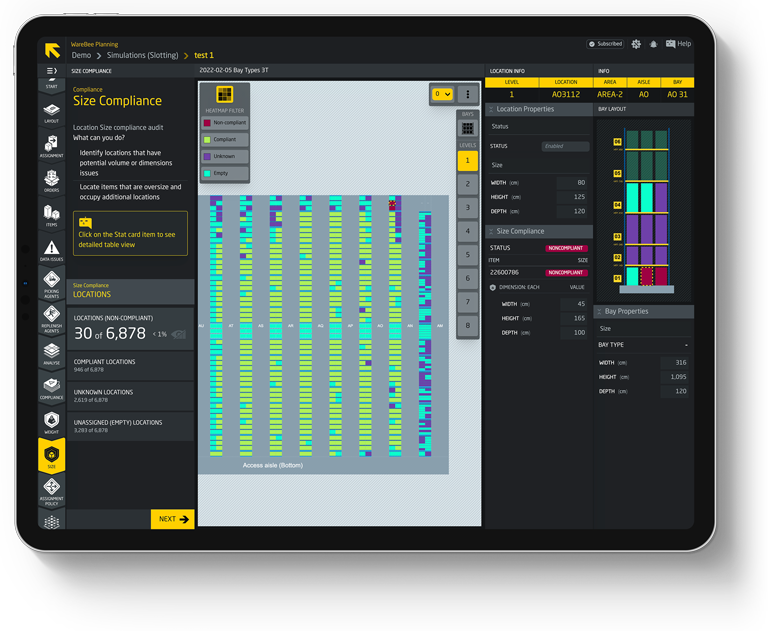
Compliance breaches
HAZMAT, storage-policy and segregation violations flagged the moment stock lands wrong.
Every putaway is checked against your rule set the moment it happens, not swept up in a nightly batch. A violation routes straight to the person accountable for that zone — shift lead, EHS or compliance owner — with the exact location cited, so the fix lands before an audit ever needs to ask.
Weight & oversize
Overloaded racking and oversized locations caught before they become a safety incident.
Live weight tallies per bay are checked against rated limits as pallets land, and footprint against slot dimensions does the same for oversize. Once either crosses the line, the zone owner gets pinged with the exact bay — not a quarterly inspection report that finds the strain after the frame already has it.
Productivity drops
Pick rates and resource utilisation sliding below target, per zone and per shift.
Live figures are compared against a rolling baseline for that zone and shift, not a fixed annual target. When the gap opens, the floor supervisor is pinged mid-shift with the resource and cause candidates attached — early enough to rebalance before the shift closes, not read about it in tomorrow's report.
Trend changes
Leading and lagging indicators shifting — a problem forming, not one already landed.
Weeks of indicator history run through the engine continuously, so a slow drift in dwell time or backlog shows up as a bending line long before any single metric crosses a red threshold. The planner watching that trend gets the early nudge — time to adjust the plan, not just react once the number is already bad.
SLA risk
On-time performance trending toward a breach, with warning before it happens.
The engine runs the maths on pace versus deadline for every order in flight, not just the final on-time tally. When a wave's trajectory says it will miss its cut-off, the ops lead is warned with the buffer window still open — enough runway to add a resource or re-sequence the wave, not just log the miss afterwards.
Data issues
Missing dimensions, wrong UOMs and orphan locations — caught before they wreck a count.
The knowledge graph cross-checks item master, location master and every incoming event against each other continuously, not just at month-end reconciliation. A SKU with no dimensions or a location nobody owns gets flagged to whoever maintains that master before a cycle count or a wave release trips over it.
The right person, the moment it matters
An alert only helps if it reaches the person who can act on it. WareBee's Scout agent monitors your WMS and IoT feeds around the clock and routes each alert to the right team in real time — measuring leading and lagging indicators so you hear about a problem while it's forming, not at the next stock count.
Caught as it happens, fixed while it's small — instead of discovered in a report after the damage is done.
- Real-time routing to the right person
- Leading and lagging indicators, watched continuously
- Caught as it happens, not at the next audit
Learn more
What is a warehouse alert engine?
A warehouse alert engine is a configurable system that watches operations against the rules and targets you set, and notifies the right people the moment reality drifts from them. The point isn't more alerts — it's the right ones, early enough to act on.
WareBee runs its Alert Engine on the digital twin, with the Scout agent monitoring WMS and IoT feeds continuously. Because it works from the same model that measures everything else, it can alert on anything the twin tracks — compliance, weight, productivity, SLA risk, data quality — using leading and lagging indicators to warn before a problem fully lands.
The result is a warehouse that surfaces its own problems while they're still small: caught as they happen, routed to whoever can fix them, and closed before they show up in a report or a failed inspection.
Frequently asked questions
How WareBee's Alert Engine watches your operation continuously and flags problems while they are still small.
What is a warehouse alert engine?
It is a configurable system that watches operations against the rules and targets you set, and notifies the right people the moment reality drifts from them. The point is not more alerts — it is the right ones, early enough to act on.
What can the Alert Engine watch for?
Compliance breaches such as HAZMAT and segregation violations, overloaded or oversized locations, productivity drops in pick rates and utilisation, shifting trend indicators, SLA risk, and data issues like missing dimensions or wrong UOMs. Anything the digital twin tracks can raise an alert.
Can I set my own thresholds, and does it need code?
You set bespoke rules on the metrics your operation actually cares about — a compliance breach, an overloaded bay, a pick rate below target, a cost-per-order creeping up. No code and no data team are required: set the threshold on any KPI the twin already tracks and WareBee watches it continuously.
How does an alert reach the right person?
The Scout agent monitors your WMS and IoT feeds around the clock and routes each alert to the right team in real time. A problem is caught as it happens and fixed while it is small, instead of discovered in a report after the damage is done.
How does it warn me before a problem fully lands?
The Alert Engine measures leading and lagging indicators, so it flags a problem while it is forming rather than after it has landed. On-time performance trending toward an SLA breach, or a pick rate starting to slide, reaches you with warning to act — not at the next stock count or audit.
Does the Alert Engine need a separate system to run?
No. It runs on the same digital twin that measures everything else and works from your existing WMS and IoT feeds, so it can alert on anything the twin tracks — compliance, weight, productivity, SLA risk or data quality — without a separate reporting project.