
Space and movement
Travel distances across picking routes were unnecessarily high, with excessive zone switching and redundant walk paths, and high-frequency SKUs were not prioritised spatially.
Case Studies / Retail & E-commerce
A major UK home-improvement retail group with hundreds of physical stores and a strong e-commerce presence, whose national distribution centre supports daily store replenishment, next-day click-and-collect and online fulfilment.
The approach
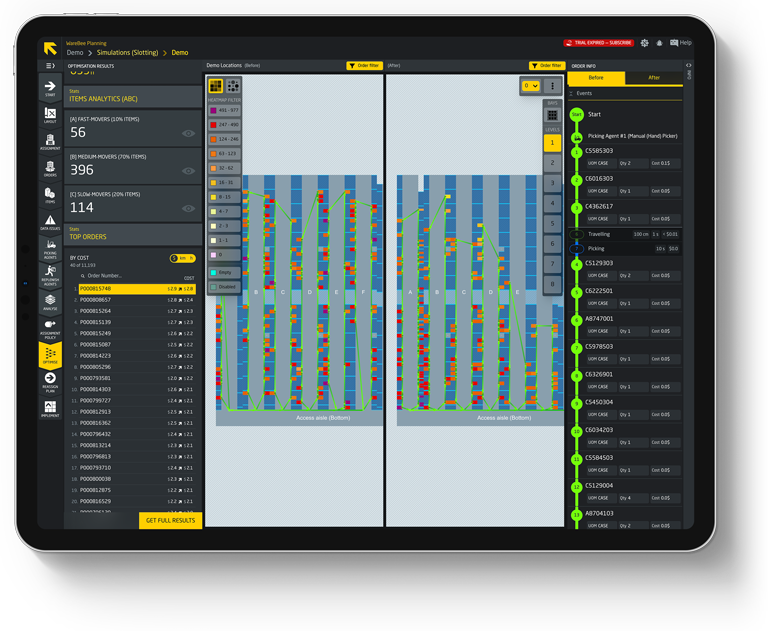
WareBee deployed its AI-powered digital twin to mirror the warehouse. By ingesting historical and real-time data, the customer's team ran scenario-based simulations to surface inefficiencies, generate recommendations and validate the business impact before any change was made on the ground.
What we found
Travel distances across picking routes were unnecessarily high, with excessive zone switching and redundant walk paths, and high-frequency SKUs were not prioritised spatially.
Containers and roll cages were underutilised, with picking density well below potential, and tote usage lacked optimisation logic, raising handling effort per shipment.
The team had limited visibility into pick density, route efficiency and SKU-placement performance, so improvement decisions were reactive rather than simulation-tested.
A few hundred items sat in non-compliant locations. Some zones were fully compliant while others deviated by up to 45%, causing misaligned workflows.
Frequent replenishment into sub-optimal locations increased handling time and walking distance.
Excessive locations visited and a sub-optimal layout led to longer routes, while low-velocity SKUs held prime real estate in high-turnover zones.
What we did
Modelled multiple pick-path and zone configurations on real data to reduce travel and congestion.
Re-slotted 5,000 SKUs by velocity, pick correlation (affinity) and ergonomic accessibility.
Analysed pick-to-container density and restructured SKU grouping to increase fill efficiency.
Activated automated alerts for slot degradation, route friction and high-variance locations.
Quantified baseline performance and simulated improvements before committing physical changes.
Scanned for violations across 13 product rules and visualised non-compliance by zone.
The outcome
WareBee delivered ROI within three months: picker walking time down 10%, the average pick route needing 14% fewer locations, and throughput up 13.5% with no system or labour changes. Shipment density rose 18%, replenishment distance fell 16%, and storage utilisation rose 9%.
Why WareBee
WareBee's digital twin lets warehouses test layout, slotting and process changes in simulation before making costly decisions. With rapid onboarding and proactive monitoring, this operation uncovered hidden inefficiencies and implemented sustainable improvements at scale.
Bring a data export to the demo and we'll build the first view of your own warehouse, not a canned one.
Required for the site to work. Bot protection (__cf_bm cookie set by Cloudflare) and form rate-limiting (one-way HMAC of your IP, 1-hour expiry). Cannot be disabled.
Anonymized traffic stats via Cloudflare Web Analytics (cookieless). Helps us understand what pages people visit.
Save-and-resume for long forms (localStorage). If off, you'll need to complete forms in one sitting.