
Replenishment and location
Storage locations were sized wrong for demand, forcing frequent replenishment. A 50,000-item catalogue added slotting complexity, with dead stock and slow movers occupying poorly chosen locations.
Case Studies / Manufacturing
A renowned European automotive leader with extensive manufacturing and distribution operations, running a state-of-the-art distribution centre that handles 50,000+ SKUs across 100,000+ storage locations, serving both just-in-time production and the replacement-parts aftermarket.
The approach
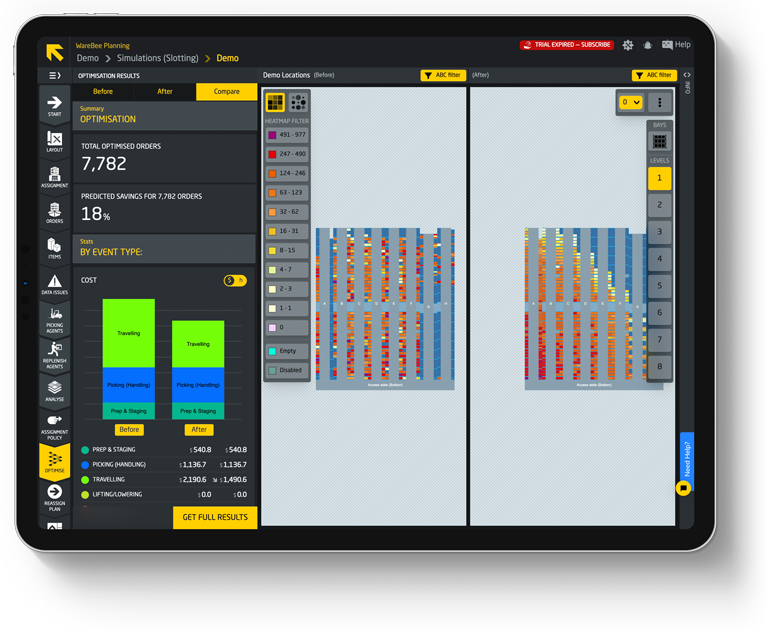
WareBee combined digital twin technology with warehouse simulations to pinpoint the operational bottlenecks and provide targeted, testable solutions, each validated in the model before it reached the floor.
What we found
Storage locations were sized wrong for demand, forcing frequent replenishment. A 50,000-item catalogue added slotting complexity, with dead stock and slow movers occupying poorly chosen locations.
Visually and physically similar SKUs were stored side by side, driving picking errors and avoidable rework.
Fast movers sat at awkward heights, causing repetitive-strain injuries and slowing picks, while routes demanded excessive walking.
The WMS lacked advanced capabilities and forced manual intervention. Excel and Power BI were too limited for accurate performance tracking.
Staffing did not track demand: overstaffed in slow periods, understaffed at the peaks that mattered.
What we did
Re-slotted fast movers to waist-height shelves to cut strain and speed picks.
Reorganised frequently picked items by affinity analysis to cut travel and improve flow.
Moved dead stock to upper and lower levels, freeing prime picking zones.
Assigned larger locations to fast movers for efficient replenishment and fewer stockouts.
Used WareBee AI for continuous monitoring and weekly re-slotting once thresholds were met.
Integrated compliance-policy monitoring, cutting manual audit effort by 90%.
Modelled options such as vertical lifts to find best-fit automation by cost, ROI and operational impact.
The outcome
Within six months, picking time fell 13% (productivity up a further 8.3 lines/hour) and labour costs dropped 15%. Picking distance fell 42% through better slotting while preserving order-demand correlation. Repetitive-strain injuries dropped 20% and storage utilisation rose 9%, absorbing future growth without expanding the footprint.
Why WareBee
WareBee keeps warehouses fit for the future through continuous improvement, data-driven insight and advanced optimisation, balancing quick wins with long-term strategy so the operation stays agile as the industry shifts.
Bring a data export to the demo and we'll build the first view of your own warehouse, not a canned one.
Required for the site to work. Bot protection (__cf_bm cookie set by Cloudflare) and form rate-limiting (one-way HMAC of your IP, 1-hour expiry). Cannot be disabled.
Anonymized traffic stats via Cloudflare Web Analytics (cookieless). Helps us understand what pages people visit.
Save-and-resume for long forms (localStorage). If off, you'll need to complete forms in one sitting.